My Son Left Me With Nothing After His Father Died — But He Didn’t Know What I Had Planned
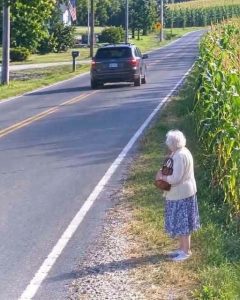
After we laid my husband to rest, my son drove me to a quiet road outside town and said, “This is where you get out. The house and the business are mine now.”
I stood in the dust, clutching my bag, as he pulled away without looking back. No phone. No cash. And that’s when I realized—I wasn’t alone. I was free… but he had no idea what I’d put in place before his father passed away…
The gravel crunched under my funeral shoes like it had been waiting for me.
I watched my son’s SUV roll forward, hesitate for half a second—just long enough to pretend this wasn’t real—then pick up speed and disappear past the bend where the cornfields start and the town stops pretending it’s still the center of the world.
I didn’t scream his name. I didn’t throw my hands up. My throat was too dry for drama, and my heart was too tired for begging.
Three days ago, I stood at the cemetery with a paper program folded in my hands and my husband’s favorite hymn stuck in my head even though we weren’t the hymn-singing type. People brought comfort the only way they knew how—Costco trays, foil pans, paper plates stacked on my counter like a quiet army. Neighbors hugged me and whispered, “He was a good man,” the way Americans say goodbye when they don’t have better language for loss.
My children flew in like they were arriving for an appointment.
My son carried himself the way men do when their lives are scheduled in fifteen-minute blocks—eyes already elsewhere, phone always face-down, like he didn’t want the screen to betray how quickly he could move on.
He talked about flights, meetings, the interstate traffic he’d “have to beat” on the way back. My daughter arrived with expensive sunglasses and a brittle smile, hugging me like she was performing tenderness for an audience.
That first night after the funeral, the house felt too quiet for two grown kids who used to fill it with noise. I made coffee out of habit and stood at the sink staring at the yard, at the bare branches that would bud soon, at the life my husband and I had built with our hands.
Then my son opened his laptop on the dining table—our dining table—and said, “We should talk about next steps.”
Next steps.
Not grief. Not memories. Not even, “Mom, are you sleeping?” Just next steps, like I was a file that needed closing.
They spoke softly, politely, the way you speak when you’re trying to move an older woman out of the way without calling it what it is. They used words like “practical” and “manageable,” and my daughter kept nodding like she’d rehearsed the nods in a bathroom mirror.
In the morning, they handed me a suitcase I didn’t recognize and told me we were going to “look at a place” that would be “good for me.”
I said, “I’m not going anywhere.”
My son smiled like he’d heard that sentence before, like resistance was just a phase. “Just come take a look, Mom. It’s easier if we do this calmly.”
So I walked through my own house—my own rooms—like a guest. I passed the living room where my husband used to fall asleep during football games. I passed the hallway where the paint still held the faint marks of my kids’ height lines.
I picked up my purse, heavier than it should’ve been, and followed them to the car because something in me wanted to see how far they’d go.
They didn’t head toward town. They didn’t get on the interstate. My son turned onto the kind of road you take when you don’t want witnesses—two lanes, no shoulders, fields on both sides, the sky wide enough to swallow a person whole.
Then he pulled over.
He turned to me and said it again, calm as a weather report: “This is where you get out.”
My daughter’s mouth opened, then closed. No argument. No refusal. Just that same brittle silence, like she was afraid any sound might crack the plan.
I stepped out. The air smelled like damp earth and early spring. Dust clung to my hem. The car door shut behind me with a soft, final click.
No phone. No cash.
Or so they believed.
I held my bag close and watched the SUV shrink until it became nothing but movement in the distance. And for the first time since the funeral, my chest loosened—not because it didn’t hurt, but because I finally understood what this was.
A clean cut. A release.
I slid my hand into the deepest pocket of my purse and felt the sharp corner of something they never knew existed—something that still carried my name from long before I became “Mom.”
Then I started walking.
.
.
The story continues in the first comment.
(I know you’re curious about the next part, so please be patient and read on in the comments below. Thank you for your understanding of the inconvenience. please leave a ‘YES’ comment below and
I was born Naomi Marie Blackwood and became Naomi Canton when I married Nicholas in 1981. For more than forty years, I carried his name proudly. When he died at sixty-eight, after fourteen difficult months of illness, I believed my greatest challenge would simply be learning to live without him.
Nicholas and I had built a modest farmhouse in Pennsylvania and transformed twenty acres of neglected apple trees into Canton Family Orchards. Our children, Brandon and Melissa, eventually moved away and built lives of their own. Neither was closely involved in the orchard, but I expected them to remain close after their father’s death.
Instead, conversations about memories quickly became conversations about money. One evening, Brandon placed a document on my table and announced that he and Melissa planned to take over the orchard. The signature looked wrong. When I questioned them, they admitted a developer wanted to purchase the property.Then they suggested I move into a retirement community. The next morning, they put my suitcase in the car and drove me toward town. Instead, Brandon stopped on a quiet road and told me to get out. Melissa remained silent as they drove away.
Fortunately, Nicholas had always insisted that I keep emergency money with me. I contacted our longtime attorney, Vincent Hargrove. After reviewing the document, he confirmed it was not the will Nicholas and I had prepared. We also discovered an older deed proving that twenty acres had been mine before our marriage.
Vincent immediately began the necessary legal process. We reviewed property records, bank documents, and business paperwork. The proposed sale was challenged, and the developer could not proceed. Eventually, Brandon and Melissa admitted they were struggling financially and believed selling the orchard would solve their problems.
They apologized, but forgiveness did not come immediately. Trust had been broken. With professional guidance, they accepted my legal rights and stopped trying to control the property. For the first time since Nicholas died, I could finally grieve without worrying about losing everything we had built.
I chose not to let bitterness become my future. I hired a manager, expanded the orchard’s educational programs, and established a scholarship fund in Nicholas’s name. Months later, Melissa asked if we could talk. I agreed, but told her rebuilding our relationship would take time.
Today, the orchard still blooms every spring. I often sit in Nicholas’s rocking chair and watch the trees sway in the wind. I learned that forgiveness does not mean forgetting, and family does not excuse betrayal. Nicholas and I spent forty years planting trees, but our greatest legacy was the life we created—and I intend to keep it growing.