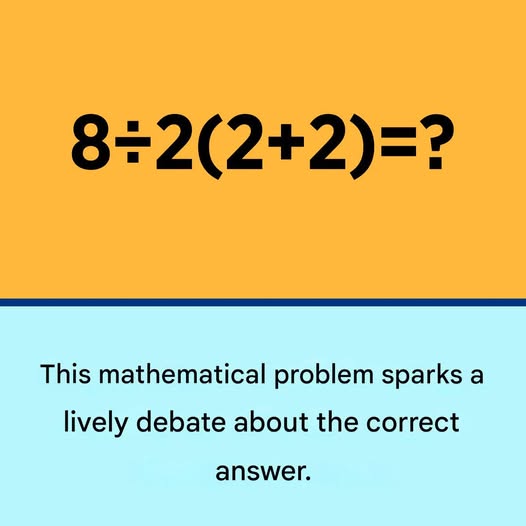
This seemingly simple equation has sparked a huge debate on the internet. Some claim the answer is 16, while others maintain it’s 1. Behind this apparently easy calculation lies a detail often overlooked: how to apply the mathematical rules. You may have already seen this equation circulating on social media, accompanied by a simple question: “What does it equal?” At first glance, the calculation seems almost child’s play… yet it has sparked endless online debates. Some swear the answer is 16, while others firmly defend the number 1. How can such a short operation provoke so much discussion? The answer lies in a detail many overlook: how mathematical rules are applied. The equation that set the internet on fire The problem is this: 8 ÷ 2(2 + 2) On the surface, nothing too complicated. Yet, since its release on the Internet in 2019, this equation has transformed into a real collective puzzle. Thousands of internet users shared their answers, each convinced they had the right one. The debate became so intense that even mathematics experts were invited to give their opinions. Why can such a short calculation divide so much? It all comes down to the interpretation of the famous order of operations rule . Understanding the order of operations rule At school, we often learn the PEMDAS rule (or BODMAS rule depending on the country). It tells us in what order to perform the operations: Parentheses Exhibitors Multiplication and division Addition and subtraction One crucial detail is often overlooked: multiplication and division have the same order of operations. Therefore, they are performed from left to right. It is precisely this point that changes everything in our equation. Why do many find the answer to be 16? Let’s start by applying the rule step by step. First, we solve the operation inside the parentheses: 2 + 2 = 4 The equation therefore becomes: 8 ÷ 2 × 4 At this stage, there remains one division and one multiplication. As they have the same order of operations, they are calculated from left to right. 8 ÷ 2 = 4 4 × 4 = 16 The answer obtained is therefore 16. This is the interpretation most commonly taught today in school textbooks. Why do some people find the answer to be 1? For other people, the equation reads differently. They consider that 2(2 + 2) forms a single block, as if it were written: 8 ÷ [2(2 + 2)] After resolving the parenthesis: 2(4) = 8 The equation then becomes: 8 ÷ 8 = 1 This reading assumes that the implicit multiplication (the 2 placed just before the parenthesis) must be dealt with before the division. This is a convention that is sometimes encountered in certain mathematical or scientific contexts. Why do mathematicians talk about ambiguity? Several specialists have explained that the real problem does not come from the calculation… but from the writing of the equation. When an expression can be interpreted in two different ways, it is called a notational ambiguity. In an article, a representative of the American Mathematical Society summarized the situation in an amusing way: by strictly following the rules of calculation , we get 16… but he understands that some read 1. In other words, the calculation is not wrong: it is the way it is written that is confusing. How to avoid this kind of debate In mathematics, clarity is essential. To avoid any confusion, it is usually enough to add parentheses. For example : 8 ÷ [2(2 + 2)] = 1 Or (8 ÷ 2)(2 + 2) = 16 With these additional parentheses, the expression becomes perfectly clear and there is no longer any ambiguity. Why is this problem so fascinating? Ultimately, this puzzle has captivated the internet because it shows an amusing thing: even in a discipline as precise as mathematics, the way a problem is written can influence how it is understood. And sometimes, a simple equation can become the starting point of a global debate among logic enthusiasts. The next time you see a calculation that is “too simple to be true,” take a moment to look at the parentheses… because they sometimes change everything. Next »